A while back I mentioned that I found the earliest known reference to the "Beavers" in an athletic context, in relation to Oregon State University.
I have been spending the occasional afternoon at the Athletic Department going over old records in their "archive," and while there I told my contact in the department that I could scan the references in question. Having now scanned the images and having sent them off, I figured I would also post them here in a public debut of the very first known documentation of "Beaver" relating to OSU. Both come from the Barometer, the school's newspaper, and both printed on November 9, 1908.
Showing posts with label Sports. Show all posts
Tuesday, May 8, 2012
Thursday, March 15, 2012
The Beavers... just how early were they?
Most OSU historians in the past have claimed that athletic teams started their association with beavers in the early 1920s. Citing personal accounts, others claim that it may have come at least a decade earlier, though until recently, this opinion was in the minority due to a lack of written sources.
They were both wrong.
Yesterday, while looking for early mentions of OAC's baseball team in The Barometer, I came across not one, but two articles mentioning the Beavers... in 1908! The first article mentioned the football team and called them the Beavers, and in the context of the article, it was clear that the author assumed the reader understood Beavers to refer to the Orangemen. On the next page, an article talked about Beaver spirit-- essentially tying the beavers with propaganda encouraging school spirit. Last week a staff member found a yearbook drawing with "Our Mascot" underneath a picture of a beaver in 1912, but the 1908 find, once properly shared, may very well lay to rest the debate.
That the term "Aggies" was used well into the 20s is also no problem-- the transition was gradual-- we just had two team names for a time, not unlike Auburn's tigers and war eagle, and the terms were shared with Beavers no matter which decade historians attribute to the addition of the team name.
They were both wrong.
Yesterday, while looking for early mentions of OAC's baseball team in The Barometer, I came across not one, but two articles mentioning the Beavers... in 1908! The first article mentioned the football team and called them the Beavers, and in the context of the article, it was clear that the author assumed the reader understood Beavers to refer to the Orangemen. On the next page, an article talked about Beaver spirit-- essentially tying the beavers with propaganda encouraging school spirit. Last week a staff member found a yearbook drawing with "Our Mascot" underneath a picture of a beaver in 1912, but the 1908 find, once properly shared, may very well lay to rest the debate.
That the term "Aggies" was used well into the 20s is also no problem-- the transition was gradual-- we just had two team names for a time, not unlike Auburn's tigers and war eagle, and the terms were shared with Beavers no matter which decade historians attribute to the addition of the team name.
Monday, February 27, 2012
Update: The Stadium that Almost Wasn't
I couple days ago a posted an entry about the failed proposal to build a joint UO/OSU stadium. I touched up the article (re-read the article and applied myself as a fact-checker, then removed some of the anti-Oregon rhetoric to make it more appropriate for a more public venue) and it then was picked up as an entry on the OSU Archives blog. (Actually the OSU Special Collections and Archives Research Center blog... but that is just being nit-picky.)
It is not much different, except that the pot-shots against the green toilet seat are removed, and a picture of the article is included.
Link to Blog Entry
It is not much different, except that the pot-shots against the green toilet seat are removed, and a picture of the article is included.
Link to Blog Entry
Saturday, February 18, 2012
OSU Football Attendance Trends
For my research project, one of the factors I decided to consider is a comparison between the OSU Football team's win/loss record and attendance at home games. If boring explanations get to you, skip to the bottom for the quick version. Everyone knows that seasons during which the team is doing well, attendance spikes, and likewise, after losing seasons attendance drops, right? I knew that the correlation had to be there, but just "knowing" the answer does not make any conclusion valid, so I did some number crunching, and I found a mildly surprising result. Based on data from Oregon State between 1946 and 1988, while attendance did tend to fluctuate in accordance with the wins percentage, the overall trend had relatively little impact. Apart from a spike during 1968 (the year after a Rose Bowl season), a spike which did not happen after the previous Rose Bowl season (1957), attendance actually stayed fairly consistent, with a gradual upward trend. Of course, it had its highs and lows, but generally those highs and lows fit the form of a gradual increase. For comparison, here are two graphs I made. (I don't have good software installed on my Mac yet, so you'll have to pardon that I don't have the graphs on a single image and that the images need to be cropped--click on the images for a bigger version.) The first graph shows the average home attendance (though as some "home" games were played in Portland's Civic Stadium, I included separate statistics for averages with and without the Portland games), while the second shows the percentage of wins in the season (wins only, no ties).
The quick version:
Average attendance at home games increased over time even though the W/L ratio generally decreased over time. Results of an individual season often result in a spike or dip in attendance, but not enough to impact the overall trend, with the exception of the 1967 Rose Bowl team.
Special thanks to the OSU Sports Information office for granting me access to its "archive," from whence the 1989 Football Media Guide supplying my data came.
Monday, January 23, 2012
The Serpentine
I have refined my topic a bit more, and although I am still hammering out an argument, I have decided that my project will revolve around school spirit at OSU up to the era of anti-establishment brought on by Vietnam. I don't have much else to report, though I thought I would share a fun photo of the "Serpentine," a tradition dating back over a century.
P217:028 064, OSU Archives (Taken from Flickr Commons)
Monday, January 16, 2012
In light of today being Martin Luther King Jr. Day, I think it is appropriate to take a look at my latest long-going projects in the Archives: Racism at OSU.
My first tale begins in 1969 when the Great Pumpkin, Dee Andros, was the head football coach at Oregon State. As is a common practice among various sports teams (the New York Yankees are perhaps the most obvious example), Coach Andros had a strict policy of his players remaining clean-shaven. Most of the team stayed within compliance of his policy, but one day in 1969, black player Fred Milton decided to grow a beard anyways. Upon his first sighting by Coach Andros, Milton was told that the beard had to go, and rather than concede, Milton stubbornly refused. After his suspension, Milton cried foul, pulling out the race card, and the 160ish-strong Black Student Union organized protests and a boycott of classes. Not much really happened in the aftermath, except that Milton transferred and a couple other black students left the team. Andros went on to become the Athletic Director, but although the incident gained international attention (I read one account of a man's friend calling about it from Turkey!), no policy changes were enacted. At a glance, this case really seems silly. I mean, what is racist about asking him to shave his beard? All the white players had equal treatment! BUT, in the words of Lee Corso, "not so fast, my friend!" In digging deeper, I discovered that, while not an inherently racist event, it was the catalyst sparking an already-present mood around campus. My final impression: stupid people did stupid racist things, so later, a harmless event channelled the existing tension and sparked a fire.
Fast-forward to the fall of 1990. The coordinator for the Black Cultural Center on campus was walking near campus when a van drove by. A member of the van hurled racial slurs, and the van sped off. Some accounts say the van even forced him to move out of the way, though the van driver was eventually cleared of all wrong-doing. In protest, the coordinator closed the BCC that Wednesday. His protest brought attention to tensions on campus which had been a real problem. In fact, he even claimed that similar events had happened at least two times prior. Fortunately, support on campus was so overwhelming that the center reopened two days later. The event also proved to have lasting effects as the university acknowledged a student request for a new educational requirement, the Difference, Power, and Discrimination portion of the Baccalaureate Core. While I personally bemoan the requirement as yet another annoying hurdle unrelated to my major (math, science, and DPD are not too separated on my interest scale), I do appreciate its importance and view its addition as a step in the right direction.
Skip ahead to 1996. Two students hurled racial slurs and attempted to urinate on a black student from an upper floor of their dorm. Coupled with the defacing of a political poster (a black student running for ASOSU President), the event sparked outrage, and led by the Black Cultural Center, the All OSU Boycott was organized. Between 1400 and 2000 (depending on the source) students participated in a silent march through campus, ending in the Quad with speeches. The two students were charged and convicted with hate crimes, and again, the tensions on campus were brought to the forefront. State-wide media covered the event, and letters to the editor at the Daily Barometer were in abundance for months. The poster-defacer was also banned from student housing for two terms. It is worth note that the victim of the urination was also the victim of another event in 1999, although no charges were filed.
As I am fairly observant of the fine line between either dwelling on the past to a fault or forgetting the past, I think revisiting events like these are healthy to do, especially on days like this which focus on such revolutionaries as Martin Luther King Jr. and the dream for which he fought. As I walk on campus in 2012, reading about past racism at OSU is shocking to me as the culture I have witnessed is vastly different from even 1996. Hopefully I am not blind about events on campus, but it seems to me that the last 15-16 years has seen great improvement at OSU.
My first tale begins in 1969 when the Great Pumpkin, Dee Andros, was the head football coach at Oregon State. As is a common practice among various sports teams (the New York Yankees are perhaps the most obvious example), Coach Andros had a strict policy of his players remaining clean-shaven. Most of the team stayed within compliance of his policy, but one day in 1969, black player Fred Milton decided to grow a beard anyways. Upon his first sighting by Coach Andros, Milton was told that the beard had to go, and rather than concede, Milton stubbornly refused. After his suspension, Milton cried foul, pulling out the race card, and the 160ish-strong Black Student Union organized protests and a boycott of classes. Not much really happened in the aftermath, except that Milton transferred and a couple other black students left the team. Andros went on to become the Athletic Director, but although the incident gained international attention (I read one account of a man's friend calling about it from Turkey!), no policy changes were enacted. At a glance, this case really seems silly. I mean, what is racist about asking him to shave his beard? All the white players had equal treatment! BUT, in the words of Lee Corso, "not so fast, my friend!" In digging deeper, I discovered that, while not an inherently racist event, it was the catalyst sparking an already-present mood around campus. My final impression: stupid people did stupid racist things, so later, a harmless event channelled the existing tension and sparked a fire.
Fast-forward to the fall of 1990. The coordinator for the Black Cultural Center on campus was walking near campus when a van drove by. A member of the van hurled racial slurs, and the van sped off. Some accounts say the van even forced him to move out of the way, though the van driver was eventually cleared of all wrong-doing. In protest, the coordinator closed the BCC that Wednesday. His protest brought attention to tensions on campus which had been a real problem. In fact, he even claimed that similar events had happened at least two times prior. Fortunately, support on campus was so overwhelming that the center reopened two days later. The event also proved to have lasting effects as the university acknowledged a student request for a new educational requirement, the Difference, Power, and Discrimination portion of the Baccalaureate Core. While I personally bemoan the requirement as yet another annoying hurdle unrelated to my major (math, science, and DPD are not too separated on my interest scale), I do appreciate its importance and view its addition as a step in the right direction.
Skip ahead to 1996. Two students hurled racial slurs and attempted to urinate on a black student from an upper floor of their dorm. Coupled with the defacing of a political poster (a black student running for ASOSU President), the event sparked outrage, and led by the Black Cultural Center, the All OSU Boycott was organized. Between 1400 and 2000 (depending on the source) students participated in a silent march through campus, ending in the Quad with speeches. The two students were charged and convicted with hate crimes, and again, the tensions on campus were brought to the forefront. State-wide media covered the event, and letters to the editor at the Daily Barometer were in abundance for months. The poster-defacer was also banned from student housing for two terms. It is worth note that the victim of the urination was also the victim of another event in 1999, although no charges were filed.
As I am fairly observant of the fine line between either dwelling on the past to a fault or forgetting the past, I think revisiting events like these are healthy to do, especially on days like this which focus on such revolutionaries as Martin Luther King Jr. and the dream for which he fought. As I walk on campus in 2012, reading about past racism at OSU is shocking to me as the culture I have witnessed is vastly different from even 1996. Hopefully I am not blind about events on campus, but it seems to me that the last 15-16 years has seen great improvement at OSU.
Wednesday, January 4, 2012
The Rose Bowl
To commemorate 70 years of bragging rights before Toilet Seat U ended its 95-year skid in the Rose Bowl this year, I hope you enjoy a couple of clips, courtesy of the OSU Archives! (I tried to embed them, but sadly, the coding isn't compatible.)
Clips from the 1941 Civil War and Homecoming Celebration
http://media.oregonstate.edu/index.php/show/1942_rose_bowl_pre-game_activities?id=0_4i04513i
Clips from the 1942 Rose Bowl
http://media.oregonstate.edu/index.php/show/1942_rose_bowl_game_footage?id=0_2dkbgo89
Clips from the 1941 Civil War and Homecoming Celebration
http://media.oregonstate.edu/index.php/show/1942_rose_bowl_pre-game_activities?id=0_4i04513i
Clips from the 1942 Rose Bowl
http://media.oregonstate.edu/index.php/show/1942_rose_bowl_game_footage?id=0_2dkbgo89
Tuesday, December 20, 2011
Football and the Fight Song
Today I enjoyed the privilege of exploring the Floyd J. "Peck" Huntley Collection. Peck was a player at Oregon Agricultural College (I believe that is the third official name of OSU) in 1909, 1910, and 1914. Included in his collection where two specific items I practically drooled over.
The first was a 1914 copy of Harold A. Wilkins' "Hail to Old O.A.C.: A Rooter's Song," the precursor to today's modern OSU Fight Song. What made me very excited was the existence of a second verse of which I had no prior knowledge. Here are the lyrics:
Here we come with a toast and song for the college up on the hill,
We love its shady slopes and trees, Its mem’ries cheer and thrill;
But fondest thoughts when the years have run, Will be of teams and vict’ries won, Each man a loyal son, Hail to old O.A.C.
Chorus:
O.A.C., our hats are off to you, Beavers, Beavers, fighters thru and thru,
We’ll cheer for ev’ry man, We’ll root for ev’ry stand, that’s made for old O.A.C.
Watch our team go tearing down the field, Men of iron, their strength will never yield.
Hail! Hail! Hail! Hail! Hail to old O.A.C.
We’ll rout hard for the baseball star who can knock out a long home run,
And cheer the man who kicks the goal, That means the game is won;
But mem’ries best in our Hall of Fame, Are for the man who’s always game, Win, lose, fights just the same, All for old O.A.C.
Repeat Chorus
The modern Fight Song only uses the Chorus with a drum and chant interlude, and the modern "Hail to OSU" includes the interlude and omits the second verse. One thing I thought especially interesting is that the modern lyrics of "O.S.U. our hats are off to you" flows much better than O.A.C.-- it is refreshing to see a name-change actually improve the song.
The other thing I saw in the collection is probably much more interesting to almost everyone besides me: a ball used in the 1914 contest between O.A.C. and Idaho, played in Portland, OR.
Compare those laces to these!
Pretty cool, huh?
Friday, March 11, 2011
Basketball, Band, and the S.W.A.T. Team
I just got back from a CRAZY couple days in LA last night! As a member of Oregon State's Travel Band, I augmented its scholarship group at the annual Pac-10 Basketball Tournament, at least until either the Men or Women lost. The trip featured way-too-early mornings, time on TV, and a police S.W.A.T. team and helicopter.
The trip started on Tuesday at Legendary Gill Coliseum where we loaded our buses. Before our buses arrived, I saw the Men's team depart. It was a bit weird seeing Craig Robinson in loose basketball sweats after only ever seeing him dressed nicely on the court. It was interesting watching the players up close and out of the spotlight.
We arrived in LA late that night, and after figuring out who was unlucky enough to sleep on the floor in our 2-bed, 4-man rooms, we got to sleep a little after midnight. The next morning, I, along with several other volunteers, reported in the lobby at 4:30 a.m. and went down to the Staples Center where KTLA was doing a live broadcast. Before we played, another mellophone player took out a can of orange spray-on hair dye, so we enjoyed orange hair for the day. We played the Fight Song in and out of commercials, got free breakfast, and got paid, so I thought it was well worth it!
Later that day was the first Women's game in USC's Galen Center where they played Arizona State. It was not expected to be close as we were the #10 seed and ASU was the #3 seed, though on the court, it was at least somewhat interesting-- they were down by a lot, but then for the last few minutes surged back to within five points, but no closer-- but we started to get really annoyed by ASU's band! Besides having a bass guitar with an annoying tinny sound (come on, really?) that made their tubas sound non-existant, they were bearable, though I was really glad when the refs told both bands to not play during the game because it got old hearing their stupid bass riff after every basket and foul (Our playing was just the drums after fouls). They also got really obnoxious too during their jeering because the did such a terrible job at heckling! While Stanford will always be the most annoying band in the conference, ASU is now my pick for either the #8 or #9 most annoying band in the Pac-10. As with any tournament, each band had its turn to play on alternating time-outs, though to be fair, during unscripted "free for alls," we did interrupt their band a couple times, though not before they started playing some boring 70s song during our Fight Song-- that is a crime you do NOT do!
After the loss, we had some free time before doing a short rally outside and heading into the Staples Center (home of the Lakers and Clippers of the NBA) to play for the Men's team against Stanford, who in addition to being annoying like ASU, are also terrible musicians since they are essentially, and self-admittedly, just a party group that happens to have instruments to go along with their beer. If you are unfamiliar with this "band," just know that they have a life-time ban at Notre Dame, recently ended a decade-long ban from the state of Oregon, and have a life-time ban from one of the major airlines.
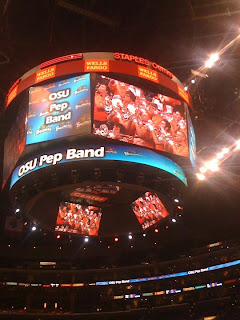
Before the game, we started trading off with the Stanford Band with some music, and when the OSU Women's team filed in to the stands, we turned to play our Fight Song to them, and they waved back since they could tell we were doing it for them (as opposed to the fans seated in that general area). During the game, we also had a bit of fun. We got on the screen several times, and I was told I was on TV numerous times as well. Sitting in front of us was Orlando Jones, an actor from the movie Drum Line, and at one point we had some fun by chanting his famous line "One band, one sound" from the movie, to which he turned around, and with a grin, gave us a wave. I also was told that Gary Payton was in the audience, though I did not see him.
The trip started on Tuesday at Legendary Gill Coliseum where we loaded our buses. Before our buses arrived, I saw the Men's team depart. It was a bit weird seeing Craig Robinson in loose basketball sweats after only ever seeing him dressed nicely on the court. It was interesting watching the players up close and out of the spotlight.
We arrived in LA late that night, and after figuring out who was unlucky enough to sleep on the floor in our 2-bed, 4-man rooms, we got to sleep a little after midnight. The next morning, I, along with several other volunteers, reported in the lobby at 4:30 a.m. and went down to the Staples Center where KTLA was doing a live broadcast. Before we played, another mellophone player took out a can of orange spray-on hair dye, so we enjoyed orange hair for the day. We played the Fight Song in and out of commercials, got free breakfast, and got paid, so I thought it was well worth it!
Later that day was the first Women's game in USC's Galen Center where they played Arizona State. It was not expected to be close as we were the #10 seed and ASU was the #3 seed, though on the court, it was at least somewhat interesting-- they were down by a lot, but then for the last few minutes surged back to within five points, but no closer-- but we started to get really annoyed by ASU's band! Besides having a bass guitar with an annoying tinny sound (come on, really?) that made their tubas sound non-existant, they were bearable, though I was really glad when the refs told both bands to not play during the game because it got old hearing their stupid bass riff after every basket and foul (Our playing was just the drums after fouls). They also got really obnoxious too during their jeering because the did such a terrible job at heckling! While Stanford will always be the most annoying band in the conference, ASU is now my pick for either the #8 or #9 most annoying band in the Pac-10. As with any tournament, each band had its turn to play on alternating time-outs, though to be fair, during unscripted "free for alls," we did interrupt their band a couple times, though not before they started playing some boring 70s song during our Fight Song-- that is a crime you do NOT do!
After the loss, we had some free time before doing a short rally outside and heading into the Staples Center (home of the Lakers and Clippers of the NBA) to play for the Men's team against Stanford, who in addition to being annoying like ASU, are also terrible musicians since they are essentially, and self-admittedly, just a party group that happens to have instruments to go along with their beer. If you are unfamiliar with this "band," just know that they have a life-time ban at Notre Dame, recently ended a decade-long ban from the state of Oregon, and have a life-time ban from one of the major airlines.
Before the game, we started trading off with the Stanford Band with some music, and when the OSU Women's team filed in to the stands, we turned to play our Fight Song to them, and they waved back since they could tell we were doing it for them (as opposed to the fans seated in that general area). During the game, we also had a bit of fun. We got on the screen several times, and I was told I was on TV numerous times as well. Sitting in front of us was Orlando Jones, an actor from the movie Drum Line, and at one point we had some fun by chanting his famous line "One band, one sound" from the movie, to which he turned around, and with a grin, gave us a wave. I also was told that Gary Payton was in the audience, though I did not see him.During the game, OSU played fairly well, and despite the most stressful 30 seconds I have ever witnessed in a basketball game, we hung on to win 69-67.
After the game was when the real craziness happened. When we got to the hotel, we were asked if anyone had a room above the 25th floor (the hotel has four towers with 32 floors each). Thankfully, none of us did. We did not really know what was going on except from rumors of a gunman. Inside the lobby, we saw police standing around, and one was even holding a shotgun! Later some of us even saw the S.W.A.T. team get into the elevator and what looked like a couple snipers, and I saw a couple of policemen with some riot gear and a cart with a shotgun attached. Inside my room I heard a helicopter, and when I realized the sound was not passing, I guessed it belonged to the LAPD as well, which turned out to be true when I went outside and saw it hovering near my room! I read the story the next morning on a KTLA report as well as what people had learned in the lobby. Apparently, a crazy man refused to leave after the hotel told him that his credit card did not process. When the LAPD came to talk to him at 7:30 p.m., he told them he had been smoking marijuana and doing narcotics, and that he had a gun, and by 4 a.m., they had put tear gas through the room's air vent before arresting him. All of this happend just a few floors above me! The funny part was that when talking about how this was one staff member's last trip with us, ironically, a comment was made that something big would happen that brought out the S.W.A.T. team.
The next day, members of the Travel Band went home while the rest stayed for next game, a loss to Arizona. It was dissappointing to go home early, though we got the last laugh because those that stayed had a really early flight the next morning instead of an afternoon flight like we had, and their per diem was not much more.
After a crazy few days, I am glad to be home, even if I no longer can enjoy the weather in Southern California... but there is always next year!
Saturday, January 22, 2011
M*A*S*H and Civil War
GO BEAVS! Watch the Civil War today, and look for me in the Beaver Dam! I'll be wearing a Beaver Dam T-Shirt and a brown beaver hat, and I will be loudly cheering on the Beavers and heckling the grellow waterfowl.
And completely unrelated... have you ever seen M*A*S*H? I was introduced to the show while in Korea (I did, of course, know what it was, just never sat down to watch it before), and instantly became a fan. It is kind of weird as it is the perfect show to watch at 5 a.m. when I can't sleep, but I am less likely to turn to it during the day, but whenever it finds its way on to my TV screen, I can't help but get really into it. My first viewing of it: Army Training on Korean Hemorhragic Fever. Yes, our training actually was watching an episode of M*A*S*H, though don't tell anyone! I'm sure the Training NCO that day would have gotten in trouble if a few certain people found out!
Tuesday, January 18, 2011
Duck Hunting
I mostly try to leave this blog kind of an "OSU-Free" zone, mainly pertaining to athletics since I banter enough already on facebook, but I need to break the silence with this one. Pictures are worth a thousand words.
BEFORE:
AFTER:
Subscribe to:
Posts (Atom)


